
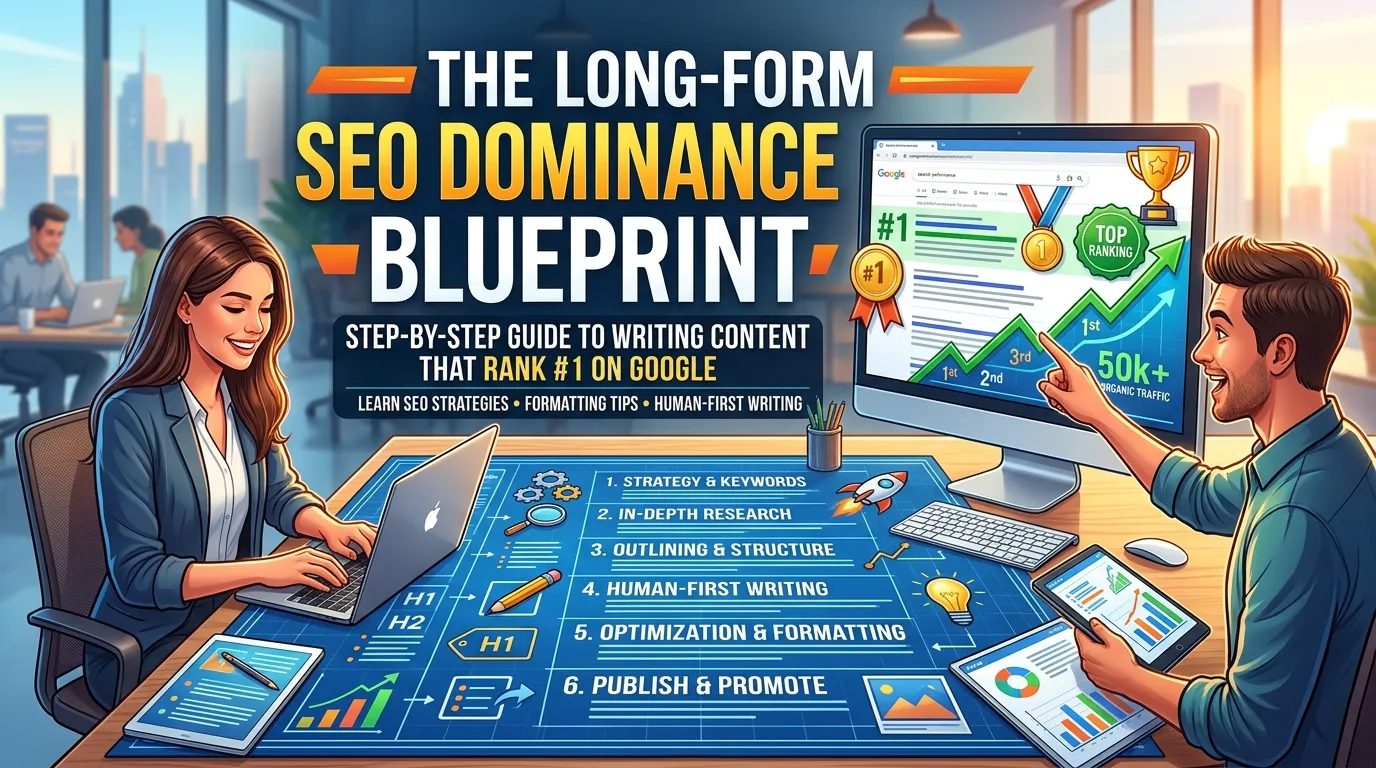
Let’s face a harsh reality of modern digital marketing, SEO, and content creation: pumping out 500-word blog posts filled with generic advice just doesn't cut it anymore. If you want to dominate search engine results pages (SERPs), capture your audience's undivided attention, and establish genuine authority in your niche, you need to master the art of long-form content.
The digital landscape has become incredibly crowded. Every single day, millions of blog posts are published. To stand out in this ocean of noise, you cannot rely on superficial overviews. You must become the definitive source of truth for your chosen topics.
But here is the catch: writing long content is easy. Anyone can mash together a bunch of loosely related paragraphs. Writing long-form content that actually ranks, engages the reader from start to finish, and converts casual browsers into loyal followers is an entirely different beast. You can't just fluff up a thin article with filler words and expect Google to reward you. The algorithm is smarter than ever, relying heavily on user experience signals, and human readers are more impatient than ever.
In this exhaustive, step-by-step guide, we are going to tear down the anatomy of top-ranking long-form content. We will move beyond the basic SEO advice you've read a hundred times and dive deep into the psychology of reader retention, semantic SEO strategies, and the structural frameworks that signal high quality to search engines. Whether you are a solo blogger, a content marketer for a SaaS company, or an entrepreneur looking to scale your organic reach, this guide will serve as your definitive blueprint for content supremacy.
What is Long-Form Content and Why Does Google Love It?
Before we get into the tactical "how," we need to deeply understand the strategic "what" and the "why." There is a massive amount of misinformation floating around about word counts, content depth, and what search engines actually want to see. Let's set the record straight once and for all.
Defining Long-Form Content Today
A few years ago, anything over 1,000 words was considered long-form. Today, the bar is significantly higher due to increased competition and more sophisticated search algorithms. In highly competitive niches (like finance, health, and marketing), long-form content typically starts at the 1,500-word mark and often extends to 3,000 words, 5,000 words, or even comprehensive pillar pages of 10,000 words.
However, defining long-form content purely by its word count is a dangerous trap. True long-form content is defined by its comprehensiveness and its ability to completely satisfy user intent. It is a definitive resource on a specific topic. It doesn't just scratch the surface; it anticipates every logical follow-up question the reader might have and answers it thoroughly. It is designed to be the very last click a user needs to make on their search journey. If someone reads your guide and still has to go back to Google to search for more information on the same topic, your content was not comprehensive enough.
The Psychology Behind Comprehensive Guides
Why does Google consistently rank massive, thousands-of-words-long guides at the top of page one? It all boils down to a single metric: user satisfaction.
Google’s ultimate goal as a search engine is to provide the best possible answer to a user's query as quickly and efficiently as possible. When a user searches for a complex, multi-faceted topic, they don't want to piece together fragmented information from ten different websites. They want a single, authoritative, well-organized source that solves their problem from A to Z.
When you provide this level of depth and quality, several magical things happen to your website's SEO metrics:
- Dwell Time Skyrockets: Readers spend five, ten, or fifteen minutes actively reading and scrolling on your page. This sends a massive, undeniable positive signal to Google's RankBrain algorithm that your content is valuable and engaging.
- Bounce Rate Plummets: Because you answer all of their immediate questions and anticipate their next ones, users have absolutely no reason to hit the "back" button (also known as pogo-sticking) and click on a competitor's site.
- Backlinks Accumulate Naturally: Other bloggers, journalists, and industry professionals are far more likely to link to a definitive, 3,000-word masterclass than a superficial 600-word opinion piece. Your content becomes a recognizable reference point in your industry.
- Social Shares Increase: People love sharing massive, ultimate guides. It makes them look smart and helpful to their own followers. This social validation drives more referral traffic and secondary SEO benefits.
The Pre-Writing Phase: Researching Like an SEO Pro
The biggest mistake amateur writers make is opening a blank document and just starting to type whatever comes to mind. Successful long-form content is 50% research and planning, and 50% execution. If your foundation is weak, your 3,000 words will collapse into an unreadable mess.
Keyword Intent over Search Volume
Amateurs obsess over search volume. Professionals obsess over search intent.
You might find a keyword with 50,000 monthly searches, but if the intent behind that keyword is transactional (e.g., "buy running shoes") and you write an informational long-form guide ("the complete history of running shoes from the 1920s to today"), you will never, ever rank. You are giving the user an apple when they are asking for a steak.
Before you write a single word, you must manually type your target keyword into Google and critically analyze the top 5 to 10 results.
- Are they listicles? (e.g., "Top 10 Ways to...")
- Are they step-by-step how-to guides?
- Are they product landing pages or e-commerce category pages?
- Are they highly opinionated thought-leadership pieces?
Google is literally handing you the cheat code. They are showing you exactly what format and angle the user wants to see. Your job is to match that format perfectly, but make your version 10x better, more detailed, more up-to-date, and more beautifully designed than the current top-ranking pages.
Analyzing the SERP Landscape for Content Gaps
Once you understand the overarching intent, you need to find the "content gaps"—the missing pieces of the puzzle that your competitors failed to include. Read the top three ranking articles for your keyword thoroughly. As you read, aggressively ask yourself:
- What crucial information are they missing?
- What logical questions did they leave unanswered?
- Is their data, research, or screenshots outdated (from 2020 or earlier)?
- Are their examples weak, generic, or non-existent?
- Is their formatting a terrifying wall of text that is exhausting to read?
- Do they lack visual aids like infographics, charts, or embedded videos?
These gaps represent your golden opportunity. If your competitors all write about "how to start a podcast" but none of them explain the technical details of RSS feeds or how to soundproof a room on a budget, that is your ticket to providing a demonstrably more comprehensive answer. You win by being the most complete resource.
Building a Bulletproof Outline
A robust, logically structured outline is the skeleton of your long-form article. Without it, you will ramble, repeat yourself, lose focus, and ultimately lose the reader's attention.
Start by listing your main H2 headings. These should cover the broad subtopics of your main keyword. Then, carefully nest H3 and H4 headings underneath them to break down the specific details, steps, or nuances.
To find the absolute best subheadings that guarantee comprehensive coverage, utilize these tools:
- Google's "People Also Ask" (PAA) box: This is a literal goldmine of exactly what your audience wants to know next. Expand the questions to see even more.
- Google Autocomplete: Start typing your main topic into the search bar and see what long-tail suggestions pop up.
- Related Searches: Scroll to the very bottom of the SERP and look at the related queries Google suggests.
- Competitor Outlines: Look at the table of contents of the top-ranking pages. Don't copy them, but ensure you are covering at least all the same ground, plus your unique additions.
- Reddit and Quora: Search your topic on these forums to see the exact wording real human beings use when asking for help.
By the time you finish your outline, you should have a clear, multi-layered roadmap. The actual process of writing the article then transforms from a daunting creative hurdle into a systematic process of filling in the blanks.
Crafting the Content: A Step-by-Step Blueprint
With your meticulous research complete and your bulletproof outline locked in, it is finally time to write. But remember, we are not just aiming for length; we are aiming for human-first, highly engaging, relentlessly valuable content.
Writing a Captivating Introduction (The Hook)
If you don't hook the reader in the first 100 words, the rest of your 3,000-word masterpiece is practically invisible. They will bounce. Your introduction must immediately validate that the reader is in the right place.
A proven, psychological framework for introductions is the Problem-Agitate-Solution (PAS) method:
- Problem: Immediately acknowledge the specific, painful problem the reader is experiencing. Make them feel understood. (e.g., "Struggling to get your beautifully written blog posts to rank anywhere near page one of Google?")
- Agitate: Make the problem feel urgent, real, and relatable. Twist the knife a little bit to build emotional resonance. (e.g., "You spend dozens of hours writing, editing, and publishing, only to check your analytics and hear crickets. It's incredibly frustrating to watch competitors with objectively inferior, poorly written content steal your traffic and your customers simply because they understand SEO better.")
- Solution: Present your article as the definitive, trustworthy cure to their pain. (e.g., "But it absolutely doesn't have to be this way. In this comprehensive, step-by-step guide, I will pull back the curtain and show you the exact, data-backed framework we used to grow our organic traffic by over 300% in just six months.")
Structuring Your Headers for Maximum Readability
Long-form content can be visually intimidating. If a tired reader clicks on your article and is greeted by a massive, unbroken wall of text, they will experience instant cognitive overload and hit the back button.
You must make your content effortlessly scannable. Use your headers (H2, H3, H4) liberally and strategically. A good rule of thumb for web writing is that a reader should never have to scroll more than a couple of times on their mobile phone without seeing a new header or visual break.
Furthermore, your headers must be highly descriptive. Instead of a vague, boring header like "The Solution" or "Step 3," use a specific, benefit-driven header like "The 3-Step Solution for Doubling Your Email Conversion Rate Overnight." The reader should be able to scroll through your article, read only the headers, and still get a solid understanding of the value you are providing.
The Power of Formatting: Bullet Points, Bold Text, and Images
Formatting is just as important as the words themselves. Poor formatting can ruin great writing. Break up your paragraphs ruthlessly. A paragraph in web writing should rarely be longer than three or four sentences. White space is your friend—it gives the reader's eyes a chance to rest.
Use advanced formatting tools to deliberately guide the reader's eye down the page:
- Bullet points and numbered lists: These are absolutely essential for breaking down complex steps, summarizing key takeaways, listing tool recommendations, or outlining examples. People love lists because they are easy to digest.
- Bold text: Highlight the most crucial sentences, statistics, or concepts within a paragraph. If a busy user only skims and reads the bold text, they should still absorb your core message.
- Images, charts, and graphs: Visuals not only break up the monotony of text but also help explain complex, abstract concepts infinitely faster than words. Original graphics, flowcharts, and infographics are highly shareable and serve as massive backlink magnets.
- Blockquotes: Use styled quotes to highlight advice from industry experts, or to emphasize a profound statement you've made. This adds authority and visual variety.
Depth over Breadth: Answering the Unasked Questions
To truly create "10x content"—content that is ten times better than the current best result—you must develop the ability to anticipate the user's next problem.
For example, if your article is about "how to train a puppy to sit," you cover the basic steps. But the user will naturally hit roadblocks and wonder, "What do I do if my puppy completely ignores the treat?" or "How long does this process usually take before it becomes permanent?" or "Does this work for older dogs too?"
By proactively answering these tangential, unasked questions within dedicated sections of your long-form guide, you prevent the user from leaving your site to return to Google. You prove that you are an absolute master of the subject matter, demonstrating immense value and expertise that builds deep trust.
Advanced SEO Tactics for Long-Form Articles
Great writing and deep empathy are the foundation, but they need a high-performance SEO engine to push them to the absolute top of the SERPs. Here are the advanced, technical tactics that move the needle for massive pieces of content.
Strategic Internal Linking
Internal linking is arguably one of the most powerful, yet criminally underutilized, SEO strategies you have full control over. It helps Google's crawlers understand the architecture and hierarchy of your site, distributes page authority (often called "link juice") to newer pages, and keeps human readers engaged with your brand for longer sessions.
Whenever you hit publish on a massive new long-form article, your work isn't done. You should immediately go back to your older, highly relevant posts and add organic internal links pointing to the new piece. Conversely, you must link out generously from your new article to your core pillar pages and product pages.
For example, if you are building an overarching content strategy to boost your site's performance, understanding how to drive initial eyeballs is a prerequisite to making long-form content work. You must combine great writing with a relentless promotion strategy. To completely master the traffic generation side of the equation, you must study our comprehensive resource: How to Increase Blog Traffic: The Ultimate Step-by-Step Guide for Explosive Growth. That guide acts as the perfect, essential companion piece to mastering the long-form content creation we are discussing here.
Semantic SEO and LSI Keywords
In the dark, early days of SEO, "keyword stuffing" (repeating the exact same phrase 50 times) actually worked. Today, it will get your site aggressively penalized. Google's algorithm now utilizes advanced Natural Language Processing (NLP) to understand the actual context and meaning of a page, much like a human does.
This means you need to shift your focus to utilizing Latent Semantic Indexing (LSI) keywords—these are terms, phrases, and synonyms that are conceptually and logically related to your primary target keyword.
If your main target keyword is "digital marketing strategy," your LSI keywords might naturally include "social media advertising," "conversion rate optimization (CRO)," "email marketing automation," "target audience demographics," and "return on investment (ROI)." Using these related terms naturally throughout your long-form content proves definitively to Google that you have a comprehensive, expert-level understanding of the entire subject matter ecosystem, not just a single, isolated keyword.
Optimizing for Featured Snippets (Position Zero)
Featured snippets—often referred to as "Position Zero"—are the holy grail of modern SEO. They appear in a dedicated box above the standard organic results and steal a massive, disproportionate portion of the click-through rate (CTR). Securing a snippet can double your traffic overnight.
To relentlessly optimize your long-form content to capture these featured snippets:
- Answer questions directly and immediately: Dedicate a specific section or an FAQ block to answering common questions directly, concisely, and without fluff (aim for a 40-50 word paragraph for the core answer).
- Use clean list formats: If the search query implies a process or a ranking (e.g., "steps to write a blog post" or "top SEO tools"), format your H2s or H3s as a clean, properly marked-up numbered or bulleted list. Google loves to scrape these lists directly into the snippet box.
- Provide clear, dictionary-style definitions: Start a section with an H2 like "What is [Your Keyword]?" and immediately follow it with a clear, unambiguous, one-sentence definition before expanding into detail.
Keeping the Human Element (Avoiding the AI Feel)
With the explosive rise of large language models and generative AI, the internet is rapidly filling up with mediocre, generic, perfectly grammatical but utterly soulless AI-generated content. While AI can be a fantastic drafting or outlining tool, relying on it to fully write and publish your long-form articles will result in robotic, generic pieces that completely fail to connect with readers on an emotional level. Furthermore, Google's algorithms are increasingly looking to reward "experience" (the new 'E' in E-E-A-T).
To truly stand out and build a loyal audience in 2026 and beyond, your content must be undeniably, unapologetically human. It must have a pulse.
Injecting Personal Anecdotes, Failures, and Case Studies
AI cannot share personal experiences because it hasn't lived them. It doesn't have a history. The single fastest way to humanize your content and build immediate rapport is to share your own stories, embarrassing failures, and hard-won successes.
Instead of just explaining a theoretical marketing concept in abstract terms, say something like: "When I first tried this backlinking strategy back in 2023, it failed miserably. I wasted three months and thousands of dollars because I completely ignored anchor text diversity. Here is exactly what I changed to finally make it work, and the exact email template I used."
Case studies provide irrefutable, real-world proof that your methods actually work. Include raw screenshots of your analytics dashboards, share specific revenue or traffic numbers, and name the exact software tools you use. This profound level of transparency builds immense trust and authority that generic, spun AI content simply cannot ever replicate.
Conversational Tone vs. Academic Jargon
Unless you are writing a peer-reviewed scientific paper for a medical journal, you must ditch the stiff, academic jargon. Write exactly like you speak to a respected colleague or a friend.
Imagine you are sitting across a coffee table from a reader, explaining your area of expertise to them over a latte. Use conversational contractions naturally (it's, you're, they'll, we've). Ask rhetorical questions to keep the reader's brain engaged and anticipating the answer. Don't use a ten-dollar, four-syllable word when a simple one-dollar word will do the job perfectly. Clarity always trumps trying to sound "smart."
A conversational, accessible tone breaks down the invisible barrier between the author and the reader, making incredibly complex, 3,000-word guides feel accessible, enjoyable, and fast-paced to read.
Active Voice and Punchy Sentence Structure
Passive voice drains the energy and momentum straight out of your writing. It makes your content sound bureaucratic, academic, and incredibly dull.
- Passive (Weak): "The keyword research for the new campaign was carefully conducted by our SEO team over the weekend."
- Active (Strong): "Our SEO team spent the entire weekend conducting rigorous keyword research for the new campaign."
The active voice is naturally punchier, more direct, and significantly easier to read. Combine this active voice with highly varied sentence lengths. Use short, sharp, two-word sentences to drive home a crucial point. Stop. Listen. Then, use longer, flowing, meticulously punctuated sentences to thoroughly explain a nuanced concept. This creates a musical rhythm and cadence to your writing that keeps the reader's brain stimulated and prevents fatigue during long reading sessions.
Post-Publishing: Promotion and Maintenance
Hitting the big "publish" button in WordPress is not the finish line; it is merely the starting gun of your long-form content's lifecycle. To truly make a piece of content rank, generate a massive ROI, and become a cornerstone asset for your business, you must actively manage and promote it.
Content Upgrades and Lead Generation Integration
If you have spent weeks meticulously researching and writing a 3,000-word masterpiece, it absolutely should be working hard for your business's bottom line. High-traffic long-form content is the single most perfect vehicle for scalable lead generation.
Don't just ask people to "subscribe to your newsletter." Create a targeted "content upgrade"—a highly relevant, incredibly valuable bonus piece of content that readers can download instantly in exchange for their email address. If your article is about SEO, the content upgrade could be a printable 50-point technical SEO checklist, a plug-and-play outreach email template, a Google Sheet content calendar, or an exclusive 15-minute video walkthrough of your process. Embed this offer organically multiple times within your text to capture high-quality leads directly from your high-ranking content.
Relentless Promotion and Link Building
You cannot rely on the "publish and pray" method. You must spend just as much time promoting your content as you did writing it.
- Email Outreach: Find articles that have linked to inferior pieces of content on your topic. Email the authors, politely point out your newly published, significantly better guide, and suggest it as a more valuable resource for their readers.
- Social Media Slicing: Do not just drop a link on Twitter and walk away. Turn your 3,000-word article into a 15-tweet thread summarizing the main points. Turn the charts into LinkedIn carousels. Turn the FAQs into short-form videos for TikTok or YouTube Shorts. Drive traffic back to the mothership.
- Community Sharing: Share the core lessons (without being spammy) in relevant Reddit communities, Facebook Groups, and Slack channels.
Tracking Metrics and Updating Stale Content
SEO is a dynamic, living ecosystem, not a "set it and forget it" game. Google heavily favors fresh, updated content, especially in fast-moving industries like tech or marketing.
Set a recurring calendar reminder to deeply review your top long-form articles every 6 to 12 months. When you review them:
- Dive into your Google Search Console (GSC) data. Are there new, unexpected long-tail keywords the page is starting to get impressions for? Add a brand new H3 section explicitly targeting those specific terms.
- Relentlessly update any outdated statistics, old dashboard screenshots, or tool recommendations that are no longer relevant.
- Run a broken link checker and fix any outbound links that lead to 404 pages.
- A/B test and improve the meta title and description if you notice your impressions are high but your click-through rate (CTR) is stubbornly low.
A simple, focused 2-hour "refresh" of an existing, aging long-form article can often powerfully bump it from position 5 or 6 straight into the number 1 spot overnight, breathing new life into your traffic.
Conclusion
Writing long-form content that actually ranks, converts, and builds authority requires a fundamental shift in your mindset. You must forcefully stop viewing content creation as a cheap factory assembly line, pumping out daily, forgettable 500-word articles just to meet a publishing quota. Instead, you must begin viewing yourself as an architect building valuable, permanent digital assets.
It takes significant time, meticulous research, deep empathy for your reader's unique problems, and a commitment to excellence. You must seamlessly combine the rigorous, technical requirements of advanced SEO—intent matching, strategic internal architecture, and semantic NLP optimization—with the irreplaceable, authentic warmth of human storytelling, vulnerability, and real-world experience.
When you fully dedicate yourself to creating the absolute best, most comprehensive, most helpful resource on the internet for your chosen topic, the results are inevitable. Google will reward you with traffic, your readers will reward you with their unwavering trust, and your business will grow exponentially.
Stop writing filler. Stop writing for algorithms. Start writing masterpieces for human beings.
Frequently Asked Questions (FAQs)
1. Exactly how many words should my long-form content be to guarantee it ranks?
There is no absolute magic number or guarantee. While long-form content typically starts around 1,500 words and often exceeds 3,000, the true goal is 100% comprehensive coverage of the topic. Look at the top 3 ranking articles for your target keyword; if they average 2,500 words, you should aim for 2,500 to 3,500 words of incredibly high-quality, actionable, fluff-free information. Never add words just to increase the count; add value.
2. Does long-form content automatically guarantee a page-one Google ranking?
Absolutely not. Word count in isolation is not a direct ranking factor. A 5,000-word article consisting of poorly written, unformatted text that doesn't answer the user's question will plummet in the rankings. Long-form content only works if it deeply satisfies user intent, is highly readable, features excellent on-page technical SEO, and is eventually supported by a solid backlink profile and internal linking structure.
3. How do I stop my long-form content from sounding like a generic AI wrote it?
The most effective way is to forcefully inject your own lived experiences. AI cannot share personal anecdotes, specific data-backed case studies from your own business, or hold strong, unique, contrarian opinions. Use a conversational tone, share your frustrating failures as well as your successes, use formatting creatively, and write strictly in the active voice. Real human nuance, humor, and empathy stand out immediately against bland AI generation.
4. How often should I include my primary target keyword in a 3,000-word article?
Forget entirely about archaic "keyword density percentages." It is an outdated metric. Focus instead on placing your primary keyword in the critical SEO priority zones: the URL slug, the SEO Title tag, the H1 title, the first 100 words of the introduction, and naturally within a couple of H2 subheadings. Beyond that, write naturally for a human reader and focus heavily on incorporating related semantic (LSI) keywords and answering the user's questions comprehensively.
5. How long does it typically take for a new piece of long-form content to rank on Google?
SEO is a marathon, not a sprint. Depending on the overall domain authority of your website, the competitiveness of the chosen keyword, and your promotional efforts, it can take anywhere from 3 to 6 months (or even up to a full year for highly competitive terms) for a new piece of long-form content to slowly climb and reach its peak ranking potential. You must be exceptionally patient and continuously promote and build backlinks to the piece during this incubation period.
6. Should I split my massive long-form guide into multiple smaller, serialized blog posts?
Generally, no. If the subtopics are tightly, logically related to a single overarching search query, it is vastly superior for SEO to have one massive, authoritative pillar page. This consolidates your backlink power onto a single URL and provides a much better, uninterrupted user experience. You should only split topics into separate posts if the search intent for the subtopics is vastly different from the main overarching topic.
7. How do I keep readers actively engaged throughout a massive 3,000+ word article without them getting bored?
You must make the content highly scannable and visually stimulating. Use frequent, highly descriptive headers, very short paragraphs (1-3 sentences), bulleted lists for data, bold text for key takeaways, blockquotes for emphasis, and plenty of high-quality images, custom graphics, or embedded videos. A reader should never feel overwhelmed by a monolithic wall of text. Engage them early with a strong, emotional introduction and keep the momentum going by delivering constant, actionable value in every single section.